
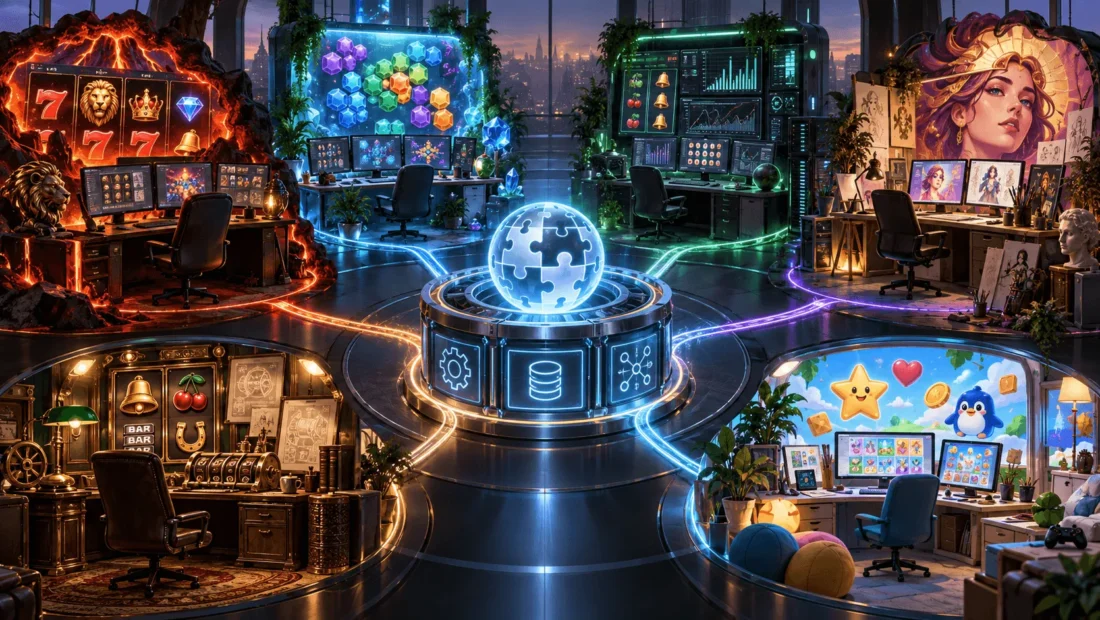
Maxxi Labs is building its new casino-content collective around a simple idea: one technical integration does not need to produce one creative identity. The company launched on September 1 with six independent studios – Bad Company, Fortune One, Gacha, Red Papaya, Slotty and Ventura Studios – each expected to preserve its own approach to visuals, mechanics, mathematics and target audiences.
The group plans to release six to eight new games every month across slots and casual formats. Rather than asking all six teams to work toward a common house style, Maxxi Labs says the point is the contrast. Operators get a single route into the portfolio, while the studios are encouraged to make products that look and play noticeably different from one another.
One Integration Without a Single House Style
Casino suppliers often use central platforms to create consistency. That can be efficient, but it also creates a risk that different releases begin to feel as though they came from the same template. Maxxi Labs is explicitly positioning its model against that outcome. The infrastructure is shared, but the creative direction is not supposed to be.
The benefit for operators is straightforward. Instead of integrating six suppliers individually, a casino can connect once and access a growing library from multiple studios. The benefit for the studios is different: they gain distribution and platform support without being asked to erase the characteristics that make their products distinct.
That separation is important because the collective is trying to address very different player segments. Some games are aimed at crypto-native or streamer-first audiences that respond to high volatility and dramatic win potential. Others use more conventional casino mechanics, branded content, casual formats or broad international themes.
Bad Company Focuses on Volatility and Big Win Potential
Bad Company occupies the high-volatility end of the portfolio. Maxxi Labs describes the studio as combining precise mathematical design with elevated win potential and polished interactive presentation. That profile is designed for players who are comfortable with larger swings and want a game to build tension around rarer but more dramatic outcomes.
High-volatility slots are a natural fit for streamer-oriented and crypto-heavy audiences because the entertainment value often comes from the possibility of an unusually large event. The challenge is keeping the underlying math coherent so that volatility feels intentional rather than chaotic. Bad Company’s role in the collective is to specialize in that balance.
Gacha Builds Around Branded Slots and Cluster Mechanics
Gacha takes a different route. The studio is focused on premium branded slots and Cluster Pays-style innovation, including a Link&Merge mechanic. Branded games need strong presentation because the visual identity carries more weight than it does in a generic theme, while cluster systems change the rhythm of play by moving away from traditional left-to-right paylines.
Maxxi Labs says Gacha pairs those mechanics with mathematics aimed at long-term engagement. That makes the studio less about a single volatility profile and more about combining recognizable entertainment properties with distinctive ways of forming wins and triggering features.
Red Papaya Takes a Data-Driven Approach
Red Papaya is described as the more data-led studio in the group. Its catalogue uses established mechanics such as Maxways, Hold & Win, Triple Pot and Bonus Tower across a wide range of themes. Those are familiar structures in modern slot design, but the studio’s role is to tune them through game-engine and performance data rather than relying entirely on novelty.
That approach can be useful in international markets where player familiarity matters. A mechanic does not need to be completely new to perform well; it needs to be packaged in a way that matches local preferences, pacing and expected feature frequency. Red Papaya appears to be the part of Maxxi Labs most directly built around that optimization mindset.
Slotty Repackages Proven Maths With New Presentation
Slotty also starts with established mathematics and mechanics, but puts more emphasis on creative reworking. The studio gives familiar structures new art, animation and audio while retaining enough flexibility to adapt titles for different markets and player groups.
That model recognizes a practical reality of casino content: players often understand and trust mechanics they have seen before. Freshness can therefore come from theme, pacing, sound and presentation rather than from rewriting the mathematical foundation of every release. Slotty’s identity is built around making proven structures feel new again.
Fortune One Leads With Art Direction
Fortune One is positioned as the presentation-led studio. Its games combine bright, polished visual direction with new mechanics intended to create memorable slot experiences. In a collective where other teams are defined by volatility, data or market flexibility, Fortune One’s point of difference is the prominence of art and creative spectacle.
That can matter commercially because casino lobbies are crowded environments. A game must first persuade a player to click before its mathematics can do anything. Strong key art, animation and instantly readable visual identity are therefore not just decorative choices; they are part of product discovery.
Ventura Studios Targets Broad Market Reach
Ventura Studios is designed for more universal distribution. The studio uses proven paytable-free mechanics and a recognizable kitsune-led visual identity, but its broader goal is to create games that can travel across markets without depending on a narrow cultural reference or highly specific player type.
That makes Ventura a useful counterweight to the more specialized studios in the group. A content collective cannot rely only on niche releases if it wants operator adoption at scale. Broad-market titles give casinos games that can sit comfortably in general lobbies while the more experimental studios serve narrower audiences.
Six to Eight Releases Every Month
The planned release pace is ambitious. Six to eight games per month means Maxxi Labs is aiming for a steady pipeline rather than occasional flagship launches. The shared integration is what makes that volume commercially interesting: operators do not need a new technical project every time another studio joins the calendar.
The risk with high output is duplication, which is why the company keeps emphasizing studio independence. If every team used the same feature set with different artwork, the collective would quickly lose its reason to exist. Maxxi Labs says its job is to protect creative autonomy while providing the distribution, infrastructure and operational reach that each studio would otherwise need to build separately.
SBC Summit Lisbon Will Be the First Major Showcase
The six-studio strategy will be shown publicly at SBC Summit Lisbon, where Maxxi Labs plans to exhibit several games covering very different formats. Mad Ducks is presented as a high-volatility, crypto-native launch slot. AviaX is a fast crash title. Cluck Hunt and Clucking Rush move into casual-game territory.
That lineup is intentionally broad. A conventional slot, a crash game and casual titles give operators a practical demonstration of what the collective means when it talks about contrast. Instead of explaining six studio identities in abstract terms, Maxxi Labs can show how the output differs on screen.
The company will exhibit at stand A401 during the Lisbon event. Its stated goal is for visitors to come away feeling that the games are unmistakably different rather than variations on the same design language.
Why the Collective Model Could Appeal to Operators
For an operator, the strongest argument is efficiency. Integrating a supplier requires technical work, testing and ongoing maintenance. If one integration unlocks multiple studios, the cost of adding variety can fall. At the same time, a broad portfolio gives casino managers more options when they build themed sections, country-specific lobbies or campaigns around different player segments.
The value only holds if the studios remain genuinely different. A six-brand wrapper around one underlying creative process would not solve the content-similarity problem. Maxxi Labs is therefore making creative independence part of the product promise, not simply an internal organizational choice.
The model is also designed to expand. More independent studios are expected to join over time, which could make the integration increasingly valuable if those teams add new formats rather than repeating what is already available. The September launch is therefore a starting structure rather than a finished catalogue.
For now, Maxxi Labs is presenting six clearly defined roles: Bad Company for high volatility, Gacha for branded and cluster-based innovation, Red Papaya for data-driven proven mechanics, Slotty for refreshed established maths, Fortune One for presentation-led creativity and Ventura for broad-market reach. The collective succeeds if those differences remain visible as the monthly release volume grows.
How Shared Infrastructure Can Scale the Model
A collective built around independent studios also has an operational advantage behind the scenes. Certification, distribution, game delivery and operator integration can be handled through a common framework while the development teams concentrate on the parts players actually notice. That separation can make it easier to add new studios later because they do not need to recreate every commercial and technical function from the ground up.
The difficult part will be preserving independence as the organisation grows. Shared tools naturally encourage shared processes, and shared processes can eventually lead to similar products. Maxxi Labs is therefore making a fairly demanding promise: centralise the infrastructure without centralising the creative decisions. The Lisbon showcase will be an early test of whether that contrast is obvious in practice.