
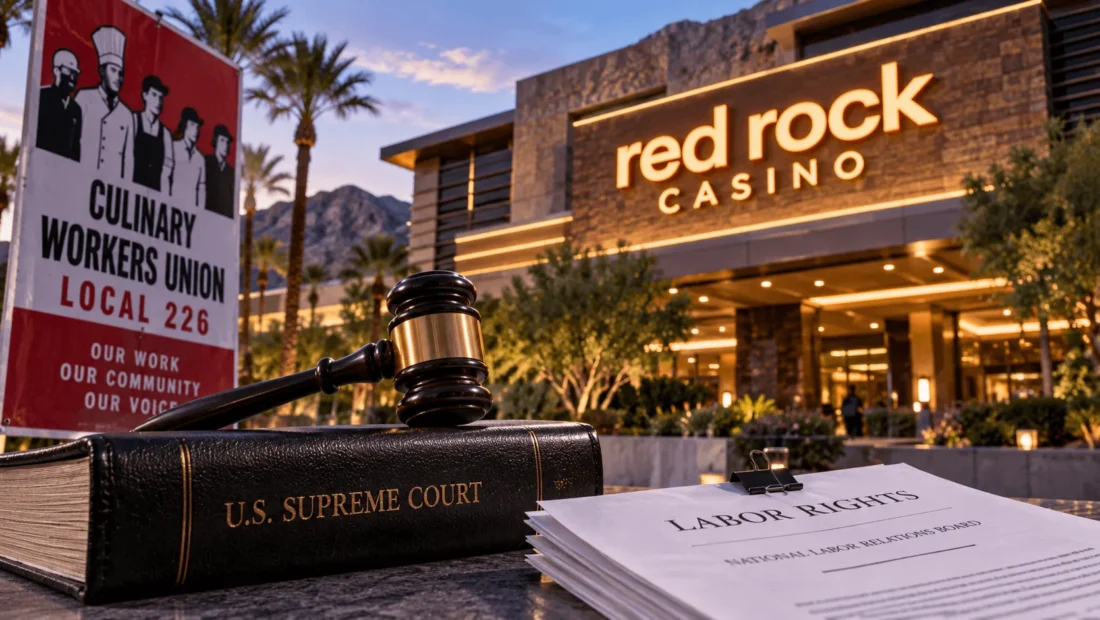
Red Rock Casino has failed to secure an emergency pause from the U.S. Supreme Court in its long-running labor dispute with Culinary Union Local 226. Chief Justice John Roberts denied the casino’s request to stay a lower-court mandate, which means Red Rock must comply with an order requiring it to recognize the union and bargain in good faith while the legal fight continues.
The immediate issue was narrow but important. Red Rock, which is wholly owned by Station Casinos LLC, wanted the Supreme Court to stop the effect of a decision from the U.S. Court of Appeals for the District of Columbia. That court had enforced an order from the National Labor Relations Board and required the casino to deal with the union. The company must also post notices advising employees of rights protected by federal labor law.
Station Casinos has said it will follow court orders, but it continues to reject the reasoning behind the NLRB decision. The company argues that the outcome disregards a secret-ballot election in which Red Rock employees voted against union representation. The union and the federal labor board, however, have focused on whether actions taken before that vote made a fair election impossible. That disagreement has been at the center of the case for years.
How the Supreme Court Request Fit Into the Case
The Supreme Court application came after Red Rock exhausted several attempts to delay enforcement in the D.C. Circuit. The appeals court had denied the company’s petition for review and granted enforcement of the bargaining order. Red Rock then sought rehearing before the full court, but that request was denied on August 6. A later request to stay the mandate while the company prepared a petition for Supreme Court review was also rejected by the D.C. Circuit on August 24.
Red Rock then turned to the Supreme Court. The company asked for a temporary pause rather than an immediate final ruling on the merits. Its position was that the bargaining mandate should not take effect while it pursued further review. Chief Justice Roberts denied that emergency request, so the lower-court order remains operative. The denial does not itself resolve every legal argument Red Rock may raise, but it removes the immediate barrier that the casino hoped would stop the bargaining obligation from taking effect.
For employees and the union, the practical consequence is straightforward: the company is expected to recognize Culinary Union Local 226 and negotiate in good faith. For Station Casinos, the result means compliance is required even though the company maintains that the labor board and courts reached the wrong conclusion.
The 2019 Election and the Benefits Dispute
The underlying conflict dates back to the union organizing effort at Red Rock in 2019. Station Casinos says it began a broader benefits improvement program on November 19 of that year as part of a company-wide strategy covering 10 properties. According to Red Rock’s Supreme Court filing, the goal was to strengthen the company’s workplace culture and make its properties more attractive employers in Las Vegas.
Two days after that rollout began, the union, which already represented employees at several other Station Casinos properties, sought to represent a group of Red Rock workers. An election followed in December. Employees rejected the union in the secret ballot. From the company’s perspective, that vote should have settled the question. Red Rock has repeatedly emphasized that its team members chose not to unionize and that a federal bargaining order overrides that decision.
The labor board viewed the sequence differently. Union representatives alleged that the timing, announcement and implementation of improved benefits affected the organizing campaign. The dispute therefore became less about whether the ballot count was clear and more about whether the environment in which the vote occurred had been altered by conduct that federal labor law does not permit. The NLRB eventually concluded that the effects were serious enough that another ordinary election would not adequately remedy the situation.
Why the NLRB Used a Gissel Order
The bargaining requirement is based on a legal remedy commonly known as a Gissel order, named for the U.S. Supreme Court’s 1969 decision in N.L.R.B. v. Gissel Packing Co. In broad terms, such an order can require an employer to bargain with a union even without a successful representation vote when unfair labor practices are found to have undermined the conditions needed for a fair election.
That is why the case has remained contentious. Red Rock argues that the remedy effectively nullifies a real election in which employees voted against union representation. The NLRB’s position is that the vote cannot be treated as decisive if the organizing environment was unlawfully influenced beforehand. Both sides therefore point to the same election but attach very different legal significance to it.
In 2022, the NLRB found that the interference was significant enough that it would be unreasonable to assume a fair rerun election could be held at the property. The board’s order was intended to address that finding by requiring bargaining rather than simply sending employees back to another vote. The D.C. Circuit later enforced the order.
Station Casinos Continues to Object
Station Casinos has framed the dispute as a case in which a company is being punished for improving compensation and benefits. Its spokesman has argued that the benefits program was not an unusual Red Rock-specific effort designed to interfere with organizing, but a broader initiative for roughly 14,000 employees across 10 properties. Nine of those properties were not Red Rock, a point the company has repeatedly used to challenge the idea that the changes were aimed at the union campaign.
The company also objects to what it sees as a conflict between employee choice and the NLRB remedy. In statements after the court rulings, Station Casinos has said the bargaining order overrides a clear vote by team members. At the same time, the company says it will comply with court orders while continuing to pursue its legal objections.
That distinction matters. Compliance with the mandate does not mean Station Casinos has accepted the board’s factual or legal conclusions. It means the company must act under the order unless and until a later court proceeding changes the legal position.
A Dispute That Has Lasted More Than a Decade
The Red Rock case also sits within a much longer conflict between Station Casinos and the Culinary Union. The Las Vegas gaming company and union representatives have been at odds for more than a decade, and labor issues involving Station properties have regularly surfaced in public proceedings before Nevada gaming regulators.
That history helps explain why the case has attracted attention beyond a single casino. For the union, Red Rock is part of a broader effort to organize workers across major Las Vegas hospitality properties. For Station Casinos, the dispute raises questions about how far the NLRB can go when it concludes that employer conduct compromised an election. The company’s filings emphasize employee choice; the board’s order emphasizes the integrity of the process that produced that choice.
The Supreme Court’s refusal to issue an emergency stay does not erase those competing narratives. What it does is shift the dispute into a new practical phase. Bargaining can no longer be postponed simply because Red Rock is still challenging the underlying order.
What Happens Next
The most immediate next step is bargaining. Red Rock is required to recognize Culinary Union Local 226 and negotiate in good faith, while also posting the notices required by the order. The source material does not indicate that a labor agreement is already in place, so the court decision should be understood as compelling the bargaining process, not guaranteeing a particular contract outcome.
Red Rock may still seek further Supreme Court review through a petition for a writ of certiorari, but the emergency request to freeze the mandate has been denied. Unless the legal posture changes, the casino must comply while any remaining appellate strategy unfolds.
For now, the core result is clear. A vote that once appeared to have ended the organizing effort has been overtaken by an NLRB remedy that survived review in the D.C. Circuit and has now avoided an emergency stay from the Supreme Court. The labor dispute is not necessarily finished, but the bargaining obligation is no longer on hold.
What the Result Means From Here
One point is already settled for the near term: the bargaining order has practical effect now. Red Rock cannot rely on the pending possibility of further review as a reason to delay recognition of the union. That gives the case a dual track, with legal arguments continuing above the day-to-day obligation to meet and negotiate. The outcome of those talks is not described in the source, but the company’s immediate duty is no longer uncertain.
The latest ruling also clarifies the difference between employee preference and the legal remedy being enforced. Red Rock continues to point to the 2019 ballot as evidence that workers rejected union representation, while the NLRB concluded that the conditions surrounding that vote were compromised. The bargaining order does not pretend the vote never happened; it reflects the board’s view that the vote cannot serve as a reliable remedy after the unfair-labor-practice findings described in the case.
That distinction will remain central if Red Rock continues seeking Supreme Court review. The company’s argument is built around the weight that should be given to the secret ballot and the timing of the benefits program. The board’s case rests on the effect of employer conduct on the organizing environment. With the emergency stay denied, those arguments can continue in court, but they no longer suspend the practical requirement to bargain.